

Look closely at the blog libraries of even well funded brands and a pattern emerges. Dozens, sometimes hundreds, of articles exist. Many target reasonable keywords. Some perform well. Yet large sections of the audience journey remain unanswered, while competitors quietly dominate important topic areas.
The issue is rarely effort. It is visibility.
Without a clear view of what the market actually demands, content strategies grow randomly. Teams publish what feels relevant or chase keywords from tools, but rarely step back to map the full informational landscape their audience is navigating.
Advanced content gap analysis changes that. It moves beyond missing keywords and reveals missing authority. Done well, it shows where competitors are building influence, where audiences are searching for answers, and where your brand has the opportunity to lead.
What Advanced Content Gap Analysis Actually Means
Basic keyword gap analysis focuses on rankings. Advanced gap analysis focuses on knowledge coverage.
The difference matters more than it might appear at first glance.
A traditional gap analysis often begins and ends with a spreadsheet of keywords. You compare domains, extract queries competitors rank for, and create new content to close those gaps. This approach can uncover useful opportunities, but it treats content like a checklist of search terms.
Advanced gap analysis looks at the ecosystem instead of individual keywords.
Instead of asking which queries competitors rank for, the more important question becomes which conversations they dominate. What themes do they consistently publish around. Which educational areas do they own. What questions do they answer repeatedly across different stages of the customer journey.
Search engines increasingly reward topical depth, not isolated pages. Authority grows when a brand demonstrates expertise across an entire subject area rather than a single keyword.
This is why modern SEO is shifting from keyword discovery to demand discovery.
Keyword discovery tells you what people search for. Demand discovery reveals why they search, what problems they are trying to solve, and what information they struggle to find.
Those insights transform content strategy. Instead of filling isolated keyword gaps, brands begin building topic ecosystems that answer real customer questions from multiple angles.
Over time this depth becomes visible to both users and search engines. It signals expertise. It builds trust. And it establishes a domain as a reliable source within its niche.
Content gaps, in this context, are not just missing articles. They are missing pieces of authority.
Why Content Gap Analysis Drives Growth for Consumer and B2B Brands
Content marketing has become one of the most widely adopted growth strategies across industries. Research shows that 82 percent of companies use content marketing, and 73 percent of B2B marketers and 70 percent of B2C marketers include it in their marketing strategy.
Yet widespread adoption has created a new challenge. Content volume is increasing faster than meaningful differentiation.
The brands that grow are not necessarily publishing more. They are publishing smarter.
Content gap analysis allows companies to transform scattered articles into structured knowledge hubs. Each missing topic becomes part of a broader ecosystem designed to educate, guide, and support audiences throughout their decision process.
The impact of this approach is measurable. According to industry research, 87 percent of B2B marketers say content marketing helps create brand awareness, while 74 percent say it generates demand and leads. These outcomes rarely come from isolated blog posts. They come from consistent topic ownership.
When a company fills important informational gaps, several strategic advantages emerge.
First, it captures competitor traffic that currently flows elsewhere. Many search queries represent unmet needs rather than saturated markets. Competitors may rank for them simply because they were early, not because their content is exceptional.
Second, filling these gaps strengthens brand authority. Readers begin to see the company as a reliable guide rather than just another vendor. Educational content creates familiarity, and familiarity often leads to trust.
Finally, gap driven content connects directly to revenue and retention. Articles that address real customer questions often support multiple stages of the buying process. They help new audiences discover the brand, assist buyers evaluating options, and continue supporting customers after purchase.
In other words, closing content gaps is not just about attracting traffic. It is about building a durable relationship between the brand and its audience.
The Core Types of Content Gaps Most Brands Miss
Despite the importance of structured content strategies, many organizations still struggle to execute them effectively. Only 29 percent of marketers say their documented content strategy is extremely or very effective, suggesting that large opportunities remain hidden in plain sight.
Several types of content gaps appear repeatedly across industries.
The most obvious are keyword and topic coverage gaps. These occur when competitors rank for relevant queries while your site has little or no content addressing them. Many companies identify these gaps, yet they often underestimate how interconnected topics can be. A single missing cluster can represent dozens of related queries and audience questions.
Another common blind spot involves buyer journey gaps. Not all content serves the same purpose. Some topics introduce new audiences to a problem. Others help readers compare solutions. Still others address concerns that appear right before purchase. When content strategies focus too heavily on one stage, important opportunities disappear elsewhere.
Format gaps are also surprisingly common. Audiences do not always want long written guides. Some questions are better answered through visuals, frameworks, case studies, or interactive tools. When competitors use varied formats, they often capture attention that text only strategies miss.
Perhaps the most important gaps involve authority and expertise. These appear when competitors consistently publish deeper analysis, more structured frameworks, or more comprehensive topic coverage. Over time, search engines recognize these signals and reward the domains that demonstrate sustained expertise.
These gaps rarely appear obvious in isolation. They emerge when content is viewed as a complete system rather than a list of articles.
Preparing for a High Impact Gap Analysis
Before analyzing competitors or keyword databases, it is essential to understand who the content is meant to serve.
Many gap analyses fail because they begin with tools rather than audiences. Without clear audience definitions, every keyword looks potentially valuable. With a defined audience, priorities become much clearer.
This preparation begins with identifying audience segments and ideal customer profiles. What problems are they trying to solve. What questions arise during their research process. What fears, uncertainties, or misconceptions shape their decisions.
These insights create the foundation for meaningful analysis.
The next step is identifying true search competitors. This is where many organizations make an important mistake. The companies competing for your customers are not always the same ones competing for search visibility.
Educational platforms, industry publications, niche blogs, and software vendors often dominate search results for informational queries. Ignoring these players creates an incomplete picture of the competitive landscape.
Finally, effective gap analysis requires a clear inventory of existing content. This includes understanding which topics the brand already covers, how those pages perform, and where authority is already developing.
Mapping the current content library reveals strengths that can be expanded as well as weaknesses that need attention. It also prevents duplicate efforts and helps teams build upon existing expertise rather than starting from scratch.
The Advanced Content Gap Analysis Framework
Once the groundwork is clear, the real work begins. A serious content gap analysis is not a single report or spreadsheet. It is a structured investigation into how knowledge flows through your industry and where your brand is absent from the conversation.
The process typically unfolds in stages. Each stage builds a clearer picture of the competitive landscape and reveals opportunities that are not obvious from keyword tools alone.
The first step is identifying competitor topic ecosystems.
Most successful content driven companies do not publish isolated articles. They build clusters of knowledge around core themes. Over time these clusters become visible patterns. One competitor might dominate educational content about industry fundamentals. Another may own the evaluation stage with comparisons, buyer guides, and product frameworks.
Analyzing these ecosystems requires looking beyond individual pages. Instead, examine how topics connect across a site. Which themes appear repeatedly. Which subjects receive deep coverage with multiple supporting articles. These patterns reveal the strategic priorities behind a competitor’s content program.
The second step involves extracting keyword and topic opportunities.
Once competitor ecosystems are visible, the next move is to map the queries and subtopics that support them. SEO tools can surface thousands of keywords, but the goal is not simply volume. The objective is to understand how those keywords form clusters that represent real audience questions.
Some clusters revolve around definitions or early education. Others focus on comparisons, implementation advice, or operational challenges. These groupings help reveal how audiences move from curiosity to decision.
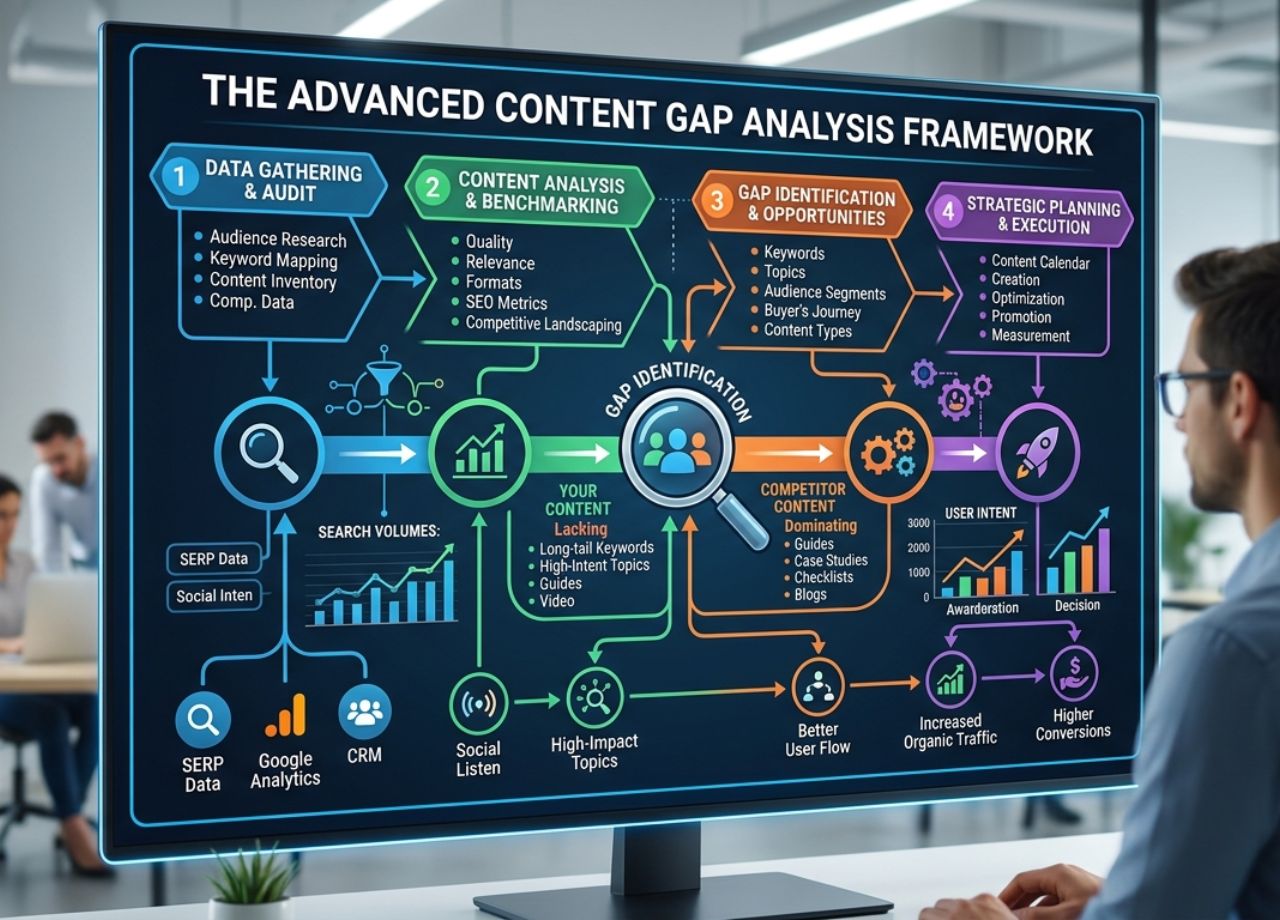
The third step filters these opportunities through relevance, authority, and intent.
Not every gap deserves attention. Some keywords may drive traffic but have little connection to your product or expertise. Others may fall far outside your current authority, making them difficult to rank for in the near term.
Effective filtering narrows the field to opportunities that align with your brand’s capabilities and strategic direction. The most valuable gaps usually sit at the intersection of strong audience demand and genuine brand expertise.
The fourth step validates opportunities through SERP analysis.
Keyword tools reveal possibilities. Search results reveal reality.
Examining the pages currently ranking for a query shows what search engines believe users expect to find. Some queries reward quick definitions. Others favor deep guides or expert commentary. Understanding these patterns prevents teams from creating content that technically targets a keyword but fails to satisfy the underlying intent.
The final step converts these validated gaps into strategic content opportunities. Each opportunity should represent a meaningful topic with the potential to support multiple pieces of content rather than a single article.
When this framework is followed carefully, content planning stops being reactive. It becomes a deliberate effort to expand authority across a defined landscape of topics.
Discovering Keyword and Topic Gaps at Scale
Once the framework is in place, large scale discovery becomes possible. This is where data tools become powerful allies, but only when interpreted with strategic intent.
One of the most effective techniques is identifying keywords competitors rank for that your site does not. At first glance this appears to be the classic gap analysis method. The real value emerges when these keywords are grouped into broader themes.
Imagine discovering that several competitors rank for dozens of queries related to implementation strategies within your industry. Individually these keywords may seem small. Together they form a clear signal. Your audience is actively searching for guidance in that area, yet your content barely addresses it.
Patterns like this often reveal entire sections of the knowledge landscape that your brand has not yet explored.
Another useful exercise is identifying topic clusters that dominate your niche.
Certain subjects naturally attract clusters of related queries. A single topic such as customer retention, product onboarding, or marketing attribution might generate hundreds of search variations. When competitors publish multiple interconnected articles covering these variations, they create a powerful signal of topical authority.
Search engines interpret this coverage as evidence of expertise. Readers interpret it as reliability.
By mapping these clusters across the competitive landscape, you can see where authority is already concentrated and where opportunities remain underdeveloped.
Search intent analysis plays a critical role here. Not every uncovered keyword represents a meaningful opportunity. Some queries reflect fleeting curiosity or extremely narrow interests.
Separating surface gaps from real opportunities requires understanding why people search for these topics. Are they seeking education, comparison, troubleshooting advice, or strategic guidance. The answer determines whether the topic aligns with your brand’s role in the industry.
This process turns raw keyword data into a structured map of audience demand.
Finding Buyer Journey and Conversion Gaps
Many content strategies fail because they concentrate heavily on the earliest stage of the buyer journey.
Educational articles that define industry concepts are relatively easy to produce and often attract search traffic. As a result, companies fill their blogs with introductory content while neglecting the stages where real buying decisions take shape.
A thorough gap analysis reveals these imbalances.
Awareness stage gaps appear when audiences search for foundational explanations that your brand has not addressed. These topics introduce readers to industry challenges and often serve as their first encounter with your company.
Consideration stage gaps emerge when potential buyers begin comparing solutions or evaluating different approaches. At this point readers want frameworks, case examples, and practical insights that help them assess options. Content that supports this stage often carries higher commercial value because it attracts users actively exploring solutions.
Decision stage gaps are even more critical. These involve queries that reflect trust, validation, and risk reduction. Buyers may search for implementation advice, real world outcomes, pricing considerations, or expert recommendations. If competitors dominate these topics, they influence the final stages of the decision process.
A fourth category receives surprisingly little attention. Post purchase and loyalty content.
Customers continue searching long after they have chosen a product or partner. They look for tutorials, optimization advice, best practices, and advanced strategies. Brands that provide this content strengthen retention while simultaneously attracting new audiences through long tail search queries.
When analyzed together, these stages reveal whether your content strategy supports the entire customer journey or only the first step.
Identifying Authority Gaps in Your Industry
Authority gaps are less obvious than keyword gaps, yet they often determine which brands dominate search results.
These gaps appear when competitors demonstrate deeper expertise across important subject areas. Instead of publishing isolated articles, they create structured ecosystems that explore topics from multiple angles.
Imagine a competitor publishing a comprehensive guide to a core industry concept. Around that pillar they add supporting articles covering implementation tactics, common mistakes, case studies, tools, and emerging trends. Each article strengthens the others.
Search engines notice this structure. Readers notice it as well.
If your brand publishes only one or two pieces on the same subject, the difference in authority becomes clear. Even if your individual article is well written, the surrounding ecosystem signals which site holds deeper expertise.
Authority gaps can also appear when entire topical clusters are missing from your content library. These clusters might represent new technologies, evolving customer expectations, or emerging regulatory considerations.
When these areas remain unexplored, your brand gradually appears less comprehensive than competitors who invest in covering them.
Closing authority gaps requires more than publishing additional articles. It requires designing content ecosystems that systematically expand your coverage of important subjects.
Over time this depth compounds. Each new piece reinforces the credibility of the others.
Identifying Demand That Competitors Have Not Captured
Some of the most valuable content opportunities do not appear in traditional gap reports.
They emerge before competitors recognize them.
Markets constantly evolve. New technologies reshape workflows. Cultural shifts alter consumer expectations. Regulatory changes introduce unfamiliar challenges. Each shift creates new questions that audiences begin asking across search engines, forums, social platforms, and professional communities.
These questions represent early signals of demand.
Brands that monitor these signals can identify topics before they become crowded. This process often involves exploring discussion platforms, customer support conversations, product reviews, and industry communities where professionals share real problems.
Patterns begin to emerge.
Certain questions appear repeatedly. Others reflect confusion about new tools or emerging practices. Some reveal misconceptions that no authoritative resource has yet clarified.
These signals point to latent demand. Interest exists, but the market has not yet produced high quality content that satisfies it.
Capturing these opportunities requires curiosity and awareness rather than just data analysis. It involves listening to the industry and recognizing when small signals indicate a larger shift.
Brands that respond early often establish themselves as the definitive resource on those topics.
Analyzing the SERP to Validate Content Gaps
Before committing resources to new content, it is essential to examine the search results themselves.
SERP analysis reveals the expectations hidden behind a query.
The first question is always intent. Are users seeking quick explanations, step by step guides, expert commentary, or product comparisons. The format of the top ranking pages usually provides the answer.
Next comes structural analysis. High ranking content often shares recognizable patterns. The same subtopics appear repeatedly. Similar frameworks organize the information. Certain questions appear in nearly every article.
These patterns reveal what search engines currently consider comprehensive coverage.
Finally, careful observation often uncovers weaknesses in the existing results. Some articles may be outdated. Others may provide only surface level explanations. Occasionally the top results fail to address important nuances of the topic.
These weaknesses create opportunities.
When a brand produces content that is clearer, deeper, and more thoughtfully structured than existing results, it does more than fill a gap. It raises the standard for what that topic deserves.
Turning Content Gaps into Topic Clusters
Identifying gaps is only the beginning. Real impact comes when those insights are turned into structured content systems.
Many teams treat each keyword as a separate article. Over time the blog fills with disconnected posts that generate occasional traffic but rarely build authority.
Search engines and readers both reward depth around a topic. When someone starts researching a subject, one answer usually leads to another question.
Topic clustering addresses this by organizing content around broader themes. A pillar page introduces the main concept, while supporting articles explore related subtopics, applications, and deeper insights.
This structure creates a connected knowledge environment where readers can move naturally between resources. It also signals topical expertise to search engines.
Clear clustering prevents overlap as well. Each article serves a distinct purpose within the ecosystem, and as new questions emerge, additional content strengthens the authority of the entire topic area.
Prioritizing Content Opportunities That Drive Authority
A thorough gap analysis often uncovers more opportunities than any team can realistically pursue. Prioritization becomes essential.
The instinct is usually to chase the highest search volume keywords. While this can generate traffic, it does not always contribute to long term authority.
A more strategic approach evaluates opportunities through three lenses. Difficulty, relevance, and demand.
Difficulty reflects the competitive strength of the pages currently ranking for a topic. Some queries are dominated by established publishers with deep authority. Others remain relatively open despite clear interest.
Relevance measures how closely the topic aligns with the brand’s expertise and strategic focus. Content connected to your core capabilities tends to build stronger credibility with both audiences and search engines.

Demand represents the depth and consistency of audience interest. Certain topics generate recurring questions across search queries, forums, and industry discussions. These signals suggest sustained need rather than temporary curiosity.
The most valuable opportunities usually sit where these three factors intersect. Some offer quicker wins with manageable competition. Others require deeper investment but contribute to long term positioning within the industry.
Balancing these categories allows teams to build momentum while steadily expanding their authority footprint.
Creating Content That Closes the Gap Better Than Competitors
Discovering a gap does not automatically create an advantage. The content that fills it must be noticeably stronger than what already exists.
Many articles struggle to rank because they simply repeat information already available elsewhere. Slightly rephrased explanations rarely add enough value to stand out.
Content that successfully closes a gap usually excels in three areas. Depth, clarity, and credibility.
Depth means exploring the subject beyond surface level definitions. The strongest resources address underlying mechanisms, practical implications, and real world context.
Clarity ensures complex ideas remain understandable. Even technical topics benefit from logical progression and well structured explanations.
Credibility reinforces both. Expert insights, reliable data, and thoughtful analysis signal that the content reflects genuine understanding.
Structure plays an important supporting role. Clear sections, logical flow, and thoughtful internal linking make the content easier to navigate and easier for search engines to interpret.
When these elements work together, the article becomes more than a search result. It becomes a resource readers return to and recommend.
Aligning Content Gap Strategy with Brand Loyalty
Traffic alone rarely builds lasting brands. Attention must eventually evolve into trust.
This is where content gap analysis connects with long term audience relationships. When companies consistently answer meaningful questions, they begin to occupy a different role in the minds of readers. They become guides rather than just vendors.
Research highlights the importance of this trust. Only about one third of consumers say they trust most of the brands they buy from. Educational content can help close that gap by offering useful knowledge without immediate sales pressure.
Over time readers begin to rely on these resources. Someone who first arrives through a search query may later return for deeper insights. Customers may revisit the same knowledge base to refine their strategies or solve new challenges.
Content ecosystems support this relationship by connecting topics into a larger learning environment. Instead of encountering isolated articles, audiences explore a network of resources that gradually expands their understanding.
This consistency strengthens familiarity with the brand while reinforcing its expertise.
Operationalizing Gap Analysis in Your Content Strategy
Content gap analysis delivers the most value when it becomes a recurring practice rather than a one time project.
Markets evolve constantly. Competitors publish new resources. Customer questions shift as technologies and expectations change. Content strategies must adapt alongside these movements.
Operationalizing gap analysis begins with establishing a repeatable workflow. Teams regularly review competitor ecosystems, evaluate emerging topics, and reassess existing clusters.
These insights can then feed directly into editorial planning. Instead of brainstorming topics in isolation, content calendars reflect opportunities discovered through structured analysis.
Periodic audits also help maintain visibility across the competitive landscape. They reveal when clusters require expansion, when new subjects begin gaining traction, and when previously strong content needs updating.
Over time this process transforms content planning into a continuous cycle of discovery and refinement.
Metrics That Show Your Gap Strategy Is Working
Traffic alone rarely reflects the full impact of a content strategy.
The disconnect appears often in marketing teams. Data highlighted in B2B marketing statistics shows that while 52 percent of B2B marketers say their content generates leads, only 33 percent believe it contributes to revenue. In many cases the issue is measurement. Teams track traffic but overlook signals that reveal authority and influence.
One of the clearest indicators is growth in topical authority. As content clusters expand, the site begins ranking for a wider range of related queries rather than a single keyword.
Another signal is broader keyword coverage. The domain gradually appears across multiple variations and long tail searches tied to the same topic.
Engagement metrics add another layer of insight. When readers move between several related resources during a visit, it suggests the content ecosystem is working.
Over time loyalty signals also emerge. Returning visitors increase and educational resources begin attracting references from industry communities.
Together these indicators show that the content strategy is strengthening the brand’s presence within its knowledge domain.
Future Proofing Content Gap Analysis in the AI Search Era
Search behavior is evolving quickly as AI driven answer engines become more prominent. Users increasingly receive synthesized responses rather than browsing through long lists of results.
This shift raises a new strategic question. Which sources do these systems trust enough to reference.
Content gap analysis now extends beyond traditional rankings. It also involves identifying opportunities where authoritative resources can contribute to these AI generated answers.
Clear explanations, structured information, and comprehensive coverage increase the likelihood that content will be surfaced and cited. Strong topical ecosystems make it easier for AI systems to interpret how knowledge connects across a domain.
The brands most visible in this environment will not simply publish more articles. They will build recognizable centers of expertise that search systems consistently draw upon when answering complex questions.